Highlights
- Wrote the guitar riff in Smoke on the Water.
- Formed Rainbow in 1975 with Ronnie James Dio on vocals.
- Since 1997 has played Renaissance-inspired folk rock in Blackmore's Night with Candice Night.
- Was a session musician and played with Screaming Lord Sutch in the early 1960s.
The story
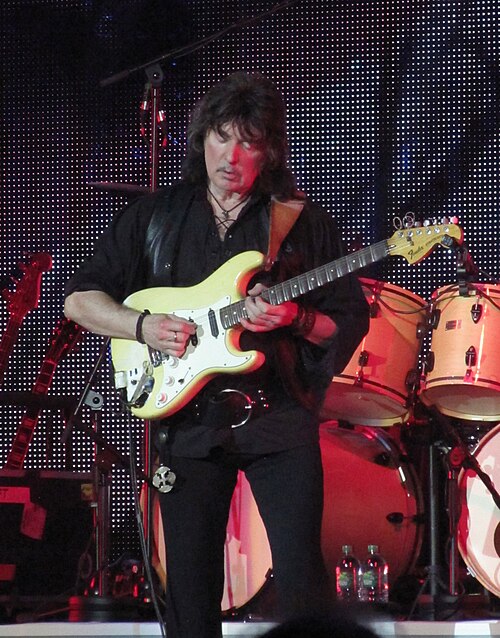
Richard Hugh Blackmore (born 14 April 1945) is an English guitarist, who was a co-founding member of Deep Purple, Rainbow and Blackmore's Night. In the 1960s, he began his professional career in bands such as the Outlaws and Screaming Lord Sutch & the Savages, and worked as a session guitarist for singers such as Glenda Collins, Heinz, Neil Christian and others.
Blackmore has been known for playing both classically influenced and blues-based solos. He is cited by publications such as Guitar World and Rolling Stone as one of the greatest and most influential guitar players of all time. He was inducted into the Rock and Roll Hall of Fame as a member of Deep Purple in April 2016.
Read more
Blackmore was born at Allendale Nursing Home in Weston-super-Mare, Somerset, the second son of Lewis J. Blackmore and Violet (née Short). The family moved to Heston, Middlesex, when Blackmore was two. He was 11 when his father gave him a guitar on the condition that he learn to play properly, so he took classical guitar lessons for one year.
In an interview with Sounds magazine in 1979, Blackmore said that he started the guitar because he wanted to be like British musician Tommy Steele, who used to just jump around and play. Blackmore loathed school and hated his teachers. He said he would always get caned for speaking in class, which traumatized him to the point he had difficulty in talking to people in subsequent years. Blackmore became fed up with formal education, thinking that if he were to excel in his studies, he would end up being like his teachers.
Blackmore left school at age 15 and started work as an apprentice radio mechanic at nearby Heathrow Airport. He took electric guitar lessons from session guitarist Big Jim Sullivan.
In 1960, he began to work as a session player for Joe Meek's music productions and performed in several bands. He was initially a member of the instrumental band the Outlaws, who played in both studio recordings and live concerts and like many bands of the era, used other names (such as The Rally Rounders and The Chaps) to secure multiple repeat gigs. Otherwise, in mainly studio recordings, he backed singer Glenda Collins, German-born rock and roll singer Heinz (playing on his top ten hit "Just Like Eddie" and "Beating Of My Heart"), and others. Thereafter, in mainly live concerts, he backed horror-themed singer Screaming Lord Sutch, beat singer Neil Christian, and others.
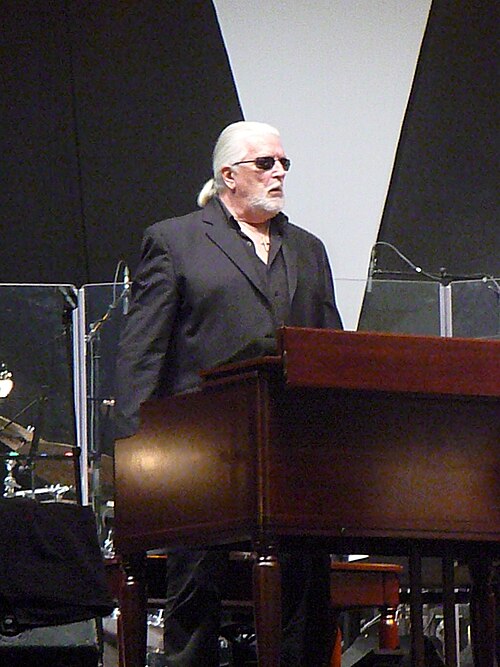
Blackmore joined a band-to-be called Roundabout in late 1967 after receiving an invitation from Chris Curtis while living in Hamburg and arriving at the Curtis flat to be greeted by Curtis' flatmate, Jon Lord. Curtis originated the concept of the band, but was forced out before the band fully formed. After the line-up for Roundabout was complete in April 1968, Blackmore is credited with suggesting the new name Deep Purple, as it was his grandmother's favourite song. Deep Purple's early sound leaned on psychedelic and progressive rock, but also included cover versions of 1960s pop songs. This "Mark One" line-up featuring singer Rod Evans and bass player Nick Simper lasted until mid-1969 and produced three studio albums. During this period, organist Jon Lord appeared to be the leader of the band, and wrote much of their original material.
The first studio album from Purple's second line-up, In Rock (1970), signalled a transition in the band's sound from progressive rock to hard rock.
From English Wikipedia (CC BY-SA) · read the full article
In Deep Purple
Other bands and projects
Most played – Blackmore solo
- 1

- 2

- 3

- 4
